Professional goals at work: Set SMART goals + 25 examples


85% of Fortune 100 companies choose Asana¹






Summary
When you plan a road trip, what do you think of first? Aside from fast food and gas mileage, road trips usually start with the destination. After all, it helps to know where you're going before you put your keys in the ignition.
The same principle applies to your career path. It's easier to progress at work when you know what goals you want to achieve, because clear objectives give you a direction and path forward. That's why professional development goals are so important; they're an opportunity to intentionally decide what you want and how you'll get there.
How to align goals and OKRs across teams
Learn how to transform your team’s goals into measurable outcomes with powerful OKRs. When teams can understand how their work ladders up to the organization’s overall goals, better results follow.
What are professional goals?
Professional goals are concrete objectives you want to achieve in your career. They typically combine short-term goals (such as taking a course this month) with long-term goals (such as becoming a manager in the next two years). Common professional goals include:
Skill development: Learning new technical or soft skills
Career advancement: Earning a promotion or transitioning to a new role
Network growth: Building professional relationships and industry connections
Leadership: Taking on management responsibilities or mentoring others
Work-life balance: Setting boundaries to prevent burnout
Long-term career goals provide a north star to work towards, while short-term goals break the work into more immediate, actionable steps.
Why do professional development goals matter?
It can be easy to stick to what you've always done, or take any opportunity that comes your way without thinking critically about what you want. But that can lead to feeling unsatisfied and directionless with your work.
Setting clear professional goals helps you in several ways:
Direction and purpose: You know you have an action plan and are working towards something you actually want to achieve.
Career satisfaction: You can pursue a position or career that truly fulfills you.
Increased motivation: Goals fuel intrinsic motivation and help you push through challenges.
Better performance: When psychologists tested different motivational techniques, they found goal setting boosted participants' performance into the 80th percentile.

The act of attempting new things helps us grow. Whether or not we achieve a specific goal, it’s the courage to try and succeed—or fail forward—that builds resilience, character, and the energy needed to propel us forward in our careers.”
How to set professional goals you care about, in 3 steps
To set the best goals, you first need to reflect on what you want. Here's how to narrow down your career aspirations and decide which objectives you want to pursue.
Create a professional development plan template1. Identify your values
Basing your professional development goals on your core values helps you feel more fulfilled on a day-to-day basis. When your goals and values align, you're less likely to burn out and more likely to stay motivated.
A good starting point is to ask yourself what's most important to you and what type of work has fulfilled you most in the past. Be honest, and try to separate your personal values from what you "should" want.
If you get stuck, try these exercises:
Imagine your ideal future self, and craft present-tense sentences about who you are in that future moment. For example: "I am honest," "I help others grow," or "I create new ideas." Try to come up with roughly three statements, and distill those down into their respective values (e.g., honesty, leadership, and creativity).
Write down the accomplishments you're most proud of, and pair each with the values they embodied. For example, if one of your fondest career moments was revamping and streamlining your team's onboarding process, efficiency and organization might be among your values.
2. Picture your ideal work role
Now that you've identified your core values, you can start to think more specifically about how they could manifest in your career. To start, try asking yourself these questions:
What do you want to do more of?
What do you want to do less of?
What type of work fulfills you the most?
What does an ideal work day look like to you?
Where do you excel?
Give yourself time to think this through; you don't need to nail everything down at once. It's normal for you (and your goals) to change over time, so remember that continuous improvement is a part of the process.
3. Write down your goals
With that internal work done, it should feel easier to set career goals. You now have a sense of what you value and how those values might apply to your professional career.
Create a professional development plan by setting your long-term goals first, then breaking them up into more immediately attainable short-term goals.
Long-term goals | Short-term goals |
|---|---|
The direction you're heading in | The stepping stones to get there |
Achieved over months or years | Achieved in days or weeks |
Example: Become a manager people trust | Example: Take a people-management course |
Whether your objectives are immediate or further out, make sure they're SMART:
Specific: Clearly define what you want to accomplish
Measurable: Include metrics to track progress
Achievable: Set goals within your capabilities
Realistic: Align with your resources and constraints
Time-bound: Set a deadline for completion
Here's what SMART professional development goals might look like:
Become a manager with at least one direct report in the next 15 months.
This week, get coffee with a manager you admire and ask for their advice.
This month, talk to your manager about potential leadership opportunities within your current role and identify three action items to help you grow.
In the next two months, take a people-management course.
25 examples of professional goals
If you feel stuck, here are different types of achievable goals to consider, along with specific examples for each.
1. Improve your time management skills
Long-term: Incorporate up to four hours of sustained focus work per day over the next six months.
Short-term: This month, set aside 90 minutes of dedicated focus time each morning.
2. Find new challenges in your role
Long-term: Manage a new project or process this year.
Short-term: In the next five weeks, take a project management course.
3. Learn a new skill
Long-term: Set a stretch goal to learn JavaScript in the next six months.
Short-term: This month, read an introductory JavaScript book and complete all practice problems.
4. Improve your work-life balance
Long-term: This year, set clear boundaries between your work and home life.
Short-term: This week, sign off completely every day by 5:30 p.m.
5. Foster team collaboration
Long-term: Identify two opportunities for cross-functional collaboration per team member over the next 12 months.
Short-term: This week, create a recurring team stand-up during which everyone can share what they're working on.
6. Expand your professional network
Long-term: Gain 50 new LinkedIn connections this year.
Short-term: Attend a conference next month to meet other industry professionals and improve your communication skills.
7. Take on leadership responsibilities
Long-term: Over the next year, coordinate 6 monthly lunch-and-learns for members of your organization.
Short-term: Volunteer to give a 30-minute presentation to your team about an area of your field this month.
8. Consume content from thought leaders in your industry
Long-term: Read 15 books written by industry leaders in your field this year.
Short-term: For a week, start each day by reading an article from a relevant publication in your industry.
9. Become an expert in the latest tech
Long-term: Learn one new tool a month for six months.
Short-term: Try a tool you've never used before on your next project.
10. Learn from those above you
Long-term: Over the next six months, study how team members in roles above you work and identify one characteristic per person that you want to emulate in your next project.
Short-term: This month, set up a 30-minute meeting with one higher-up in your organization and ask for tips on how to advance in your career.
11. Become a thought leader
Long-term: Over the next quarter, devote at least two hours per week to writing articles about trends in your industry.
Short-term: Write a LinkedIn post this week about something that interests you in your field and offer your thoughts on it.
12. Broaden your skill set
Long-term: In the next six months, take a class in something different but applicable to your field.
Short-term: Set up a 30-minute meeting this month with someone in a different department to learn more about what they do.
13. Track your success
Long-term: Create a list of what qualifies as success in your field, then try to increase it by an achievable margin each month.
Short-term: Think of one "quick win" you can get this week and accomplish it in order to boost your motivation.
14. Go above and beyond with your work
Long-term: In the next quarter, deliver all work at least two business days before it's due.
Short-term: The next time your manager asks for help, offer to assist, even if it's not something you'd typically work on.
15. Limit distractions
Long-term: This quarter, spend up to $500 creating a workspace and routine that enhances your focus and deters distractions.
Short-term: Turn off notifications on your phone during the workday every day this week.
16. Nurture relationships
Long-term: The next time you shift jobs, identify three colleagues you want to stay in touch with and set up monthly chats with them.
Short-term: Reach out to someone in your field to learn more about their day-to-day this month.
17. Be vocal about your goals
Long-term: This year, share your work goals with your team and manager via a work management tool, and send status updates on a monthly basis.
Short-term: Tell your manager what your aspirations are and ask for their advice on how to get there in your next 1:1.
18. Identify your weaknesses
Long-term: Over the next six months, volunteer yourself to work on at least two projects that require professional skills that you're weaker at.
Short-term: Identify one hard or soft skill you need to improve and dedicate a week to improving it.
19. Prioritize self-care
Long-term: For the next three months, maintain a routine that incorporates at least two healthy non-work-related habits like exercise, meditation, and healthy eating.
Short-term: Hold yourself accountable to getting seven to nine hours of sleep each night for a week.
20. Learn constantly
Long-term: Take one online course in the next six months to polish and grow your skills.
Short-term: Subscribe to a weekly newsletter that highlights major topics in your field.
21. Help your teammates
Long-term: This year, identify a process in your organization that could use a refresh and create a plan for how to improve it.
Short-term: In your next 1:1 with your manager, ask how you can make their job easier.
22. Improve communication skills
Long-term: Take a presentation course and lead an all-team presentation by the end of this year.
Short-term: Next time you're sending an email, read it through a few times and pinpoint two places where you can improve your language.
23. Be vocal about your opinions
Long-term: Share your opinions about aspects of your industry on LinkedIn once a month for six months.
Short-term: Offer your opinion at your next team meeting or brainstorm.
24. Give the best feedback
Long-term: By the end of this quarter, practice and master the COIN model of feedback to ensure you're always focusing on the "why" when you give project recommendations.
Short-term: Share one piece of positive feedback during your next 1:1 meeting.
25. Create new responsibilities for yourself
Long-term: By the end of the year, establish recurring office hours about something you're an expert in at your organization.
Short-term: In the next month, coordinate a 60-minute brainstorm with your team.
Professional goals in real life
At Asana, we believe that goals can unlock our best selves and help us be more productive. In that spirit, here's how three Asanas have used professional goals to foster their career and personal development.
Changing roles within an organization
"A professional goal I set was to transition from a risk management role at a tech company to the legal field. After seeking advice from paralegals and attorneys in my network, I realized I could transition without leaving my company.
I started volunteering for projects where I could collaborate with our in-house legal team. I kept a close watch on open positions, and eventually, two roles became available that fit my skill set. I applied for both, documented my transferable skills, and was offered both roles; I've been in Legal ever since!" ,Charlotte Manning, Legal Operations at Asana
Seeking new challenges within a role
"One of the most impactful professional goals I've achieved has been the creation and evolution of Asana's Anatomy of Work Index. What started as a smaller goal to create a topical piece of thought leadership has quickly grown into our landmark industry report and one of our most prominent annual campaigns. It's enabled me to work cross-functionally across our entire organization and hone my own skill set on full-funnel campaigns and storytelling for internal and external audiences." ,Erin Cheng, Head of Public Relations and Analyst Relations at Asana
Pursuing a new degree
"When I worked at a science museum, I was once in a meeting where every leader had a master's degree or a PhD. Imposter syndrome had kept me from pursuing education beyond my BA, but with 20+ years of work experience, I finally felt ready. This May, I graduated from USF with a Master's in Organizational Development.
It wasn't so much achieving my goal as the process that was transformative. While in the program, I daydreamed about a career focused on Diversity, Inclusion, and Belonging work, and before my program ended, I found myself at Asana doing just that!" ,Liliana Blanco, Inclusion & Belonging Program Manager at Asana
Tips to keep your goals on track
Setting professional goals is an important step, but it's equally important to follow through. Once you've set your professional goals, try these three tips to stick with them.
![[inline illustration] tips to keep professional goals on track (infographic)](https://assets.asana.biz/transform/e2571a57-1590-4589-b3ed-b4f110bf9247/inline-goals-professional-goals-2-2x?io=transform:fill,width:2560&format=webp)
Create short-term goals
This is most helpful if your long-term goals are broader. For example, the long-term goal "Set clear boundaries between your work and home life this year" isn't very specific or quantifiable.
In this case, it's a good idea to set more quantifiable short-term goals to support what "clear boundaries" mean to you, such as "This week, sign off every day at 5:30 p.m." When you create these smaller milestones, the work feels less daunting, and you're less likely to procrastinate.
Schedule regular check-ins
Don't just set goals and forget them; decide in advance how often you'll check in to see how you're tracking towards each milestone. Establishing a regular check-in cadence helps you stay accountable and avoid procrastination.
For example, if you've set a goal to write 10 blog posts this month, schedule time at the end of each week to track your progress.
Use goal tracking software
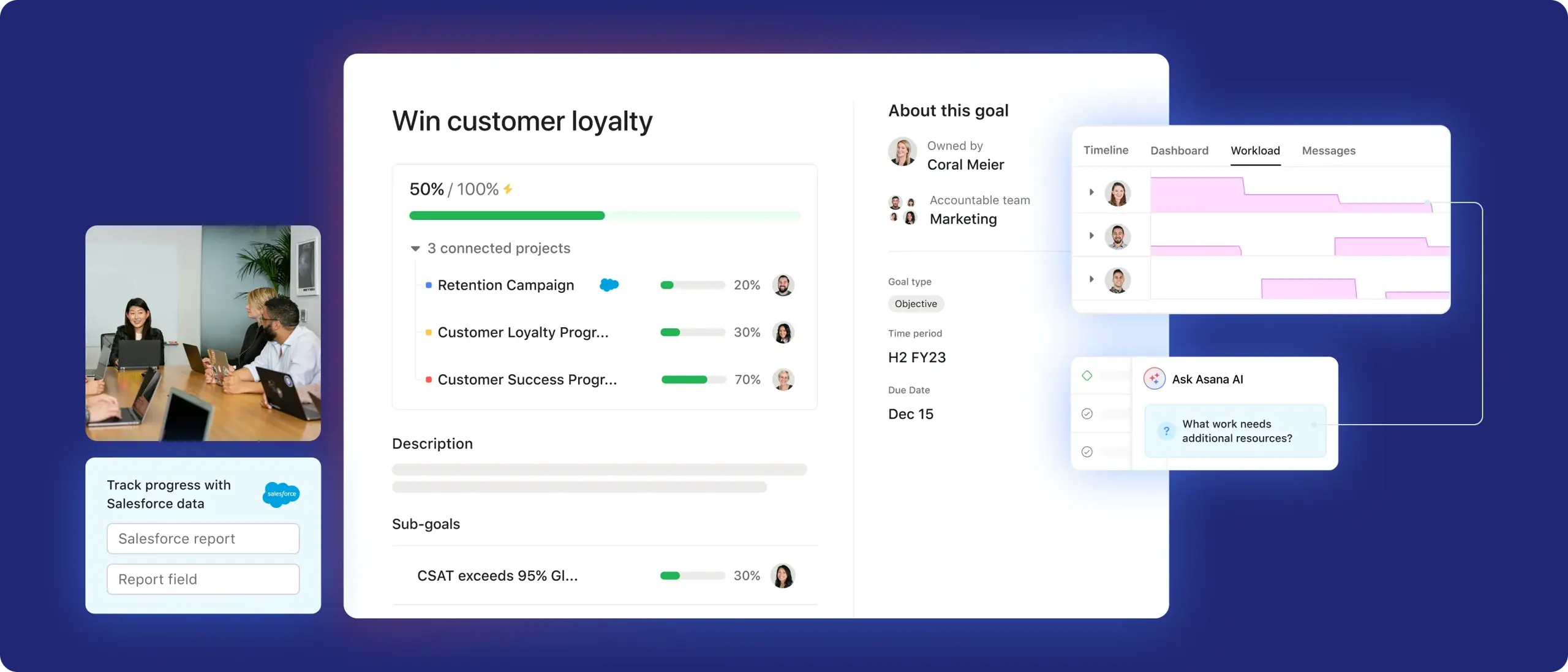
Goals work best when they're tied to your day-to-day work. That's why Asana connects tasks and projects to the goals they support, so you know at a glance why your day-to-day work is important.
When you use goal tracking software in Asana, you can set a due date and create automated reminders to update your goal progress. Within each goal, you can create sub-goals to help you break work down into manageable chunks.
Grow with intention
Professional development goals are one of the best ways to build the career you want. Setting goals helps you actively decide what to pursue and how you'll get there, so each day you know you're progressing towards something that matters.
And while change can feel daunting, professional goals give you peace of mind, knowing that you have a clear purpose and path to achieve your career aspirations. Ready to start tracking your professional goals? Get started with Asana to connect your daily tasks to your larger career objectives.
Create a professional development plan templateFrequently asked questions about professional goals
SMART is an acronym for Specific, Measurable, Achievable, Realistic, and Time-bound, criteria that help you create clear, trackable goals. For example, instead of "get better at public speaking," a SMART goal would be: "Complete a public speaking course and lead one team presentation in the next quarter."
Frame your answer to show how you hope to grow within the role and contribute to the team. Connect your short-term goals (like mastering a new skill) to your long-term aspirations of taking on more responsibility within the organization.
Professional goals are tied to your career (like earning a promotion), while personal goals relate to other areas of your life (like health or hobbies). While distinct, personal goals can support professional ones; for instance, reading more books might help you become a better writer at work.
Check in on short-term goals weekly or bi-weekly to track progress. For long-term goals, a quarterly review with your manager helps you stay accountable and adjust if priorities change.