Strategic planning helps you clearly define your company's long-term objectives and maps how your short-term goals and work will help you achieve them. This, in turn, gives you a clear sense of where your organization is going and allows you to ensure your teams are working on projects that make the most impact. Think of it this way: if your goals and objectives are your destination on a map, your strategic plan is your navigation system.
In this article, we walk you through the 5-step strategic planning process and show you how to get started developing your own strategic plan.
Leverage AI-driven solutions to unleash your team's potential with dynamic workflows that adapt to ever-changing business needs and drive company-wide success.
Strategic planning is the process of defining your organization's direction and allocating resources to achieve long-term goals. It typically covers a three- to five-year horizon and results in a strategic plan that guides company-wide decision-making. During this process, stakeholders review the organization's mission, conduct competitive assessments, and set measurable objectives.
A strategic plan is the end result of the strategic planning process. At its most basic, it's a tool for defining your organization's goals and the actions you'll take to achieve them.
Typically, your strategic plan should include:
Your company's mission statement
Your organizational goals, including your long-term goals and short-term, yearly objectives
Any plan of action, tactics, or approaches you plan to take to meet those goals
Strategic management is the ongoing process of setting goals, deploying resources, and executing on strategy to guide the company toward its vision through continuous improvement. While strategic planning focuses on creating the plan, strategic management is the broader way that includes planning, implementation, and continuous review.
Strategic planning | Strategic management |
|---|---|
Creates the roadmap | Executes and monitors the roadmap |
Defines goals and objectives | Allocates resources to achieve goals |
Typically occurs every 3-5 years | Ongoing, continuous process |
Results in a strategic plan document | Results in organizational alignment and adaptability |
Strategic management includes strategic planning but goes beyond it, helping you organize resources and determine the best action plans for success.
Get our free ebook and learn how to bridge the gap between mission, strategic goals, and work at your organization.
Strategic planning can help with goal setting and decision-making by mapping how your company will move toward your organization's vision and mission statements over the next three to five years. Let's circle back to our map metaphor. If you think of your company trajectory as a line on a map, a strategic plan can help you better quantify how you'll get from point A (where you are now) to point B (where you want to be in a few years).
When you create and share a clear strategic plan with your team, you can:
Build alignment: Unite departments and teams around a shared purpose, mission, and vision.
Set clear goals: Define long-term objectives and the short-term milestones that support them.
Prioritize resources: Allocate time, budget, and talent to your most high-impact initiatives.
Think long-term: Promote sustainable growth rather than short-term gains.
Identify risks and opportunities: Assess your current situation and respond swiftly to market changes
Strengthen culture: Create a business environment where teams understand how their work contributes to company success.
The strategic planning process is a structured methodology that guides your organization from vision to implementation. It starts with assembling a dedicated team of five to 10 key strategic planners who form your management committee.
This committee is responsible for:
Gathering information: Collecting data from stakeholders, customers, and market research
Guiding development: Shaping the strategic plan's direction and priorities
Overseeing execution: Monitoring progress and ensuring accountability
Once you've established your management committee, you can get to work on the planning process.
Get our free ebook and learn how to bridge the gap between mission, strategic goals, and work at your organization.
Before you can define where you're going, you first need to define where you are. Understanding the external environment, including market trends and competitive landscape, is crucial in the initial assessment phase of strategic planning.
To do this, your management committee should collect information from additional stakeholders, such as employees and customers. In particular, plan to gather:
Relevant industry and market data to inform any market opportunities, as well as any potential upcoming threats in the near future.
Customer insights to understand what your customers want from your company, like product improvements or additional services.
Employee feedback that needs to be addressed, whether about the product, business practices, or the day-to-day company culture.
Consider different types of strategic planning tools and analytical techniques to gather this information, such as:
A balanced scorecard to help you evaluate four major elements of a business: learning and growth, business processes, customer satisfaction, and financial performance.
A SWOT analysis or PEST analysis to help you assess both current and future potential for the business (you'll return to these analyses periodically during the strategic planning process).
To fill out each letter in the SWOT acronym, your management committee will answer a series of questions:
Strengths:
What does your organization currently do well?
What separates you from your competitors?
What are your most valuable internal resources?
What tangible assets do you have?
What is your biggest strength?
Weaknesses:
What does your organization do poorly?
What do you currently lack (whether that's a product, resource, or process)?
What do your competitors do better than you?
What, if any, limitations are holding your organization back?
What processes or products need improvement?
Opportunities:
What opportunities does your organization have?
How can you leverage your unique company strengths?
Are there any trends that you can take advantage of?
How can you capitalize on marketing or press opportunities?
Is there an emerging need for your product or service?
Threats:
What emerging competitors should you keep an eye on?
Are there any weaknesses that expose your organization to risk?
Have you or could you experience negative press that could reduce market share?
Is there a chance of changing customer attitudes towards your company?
To begin strategy development, take into account your current position, which is where you are now. Then, draw inspiration from your vision, mission, and current position to identify and define your goals and objectives; these are your final destination.
To develop your strategy, you're essentially pulling out your compass and asking, "Where are we going next?" "What's the ideal future state of this company?" This can help you figure out which path you need to take to get there.
During this phase of the planning process, take inspiration from important company documents, such as:
Your mission statement is to understand how you can continue moving towards your organization's core purpose.
Your vision statement clarifies how your strategic plan fits into your long-term vision.
Your company values guide you towards what matters most to your company.
Your competitive advantages help you understand what unique benefit you offer to the market.
Your long-term goals are to track where you want to be in five or 10 years.
Your financial forecast and projection is where you expect your financials to be in the next three years, what your expected cash flow is, and what new opportunities you will likely be able to invest in.
Get our free ebook and learn how to bridge the gap between mission, strategic goals, and work at your organization.
Now that you understand where you are and where you want to go, it's time to put pen to paper. Take your current business position and strategy, as well as your organization's goals and objectives, into account, and build a strategic plan for the next three to five years. Keep in mind that, even though you're creating a long-term plan, parts of it should be created or revisited as the quarters and years go on.
As you build your strategic plan, you should define:
Company priorities: Your top focus areas for the next three to five years, informed by your SWOT analysis.
Yearly objectives: Specific goals for the first year that connect to your overall strategic goals, with new objectives added annually.
Key resultsand key performance indicators (KPIs): Measurable indicators set by leadership and individual teams to track progress.
Budget: Financial allocation for your most important initiatives based on your forecast and strategic direction.
A high-level strategic roadmap (project roadmap): A timeline outlining what you expect to work on each quarter or year
Now it's time to put your plan into action. Strategy implementation involves clear communication across your entire organization to ensure everyone understands their responsibilities and how to measure the plan's success.
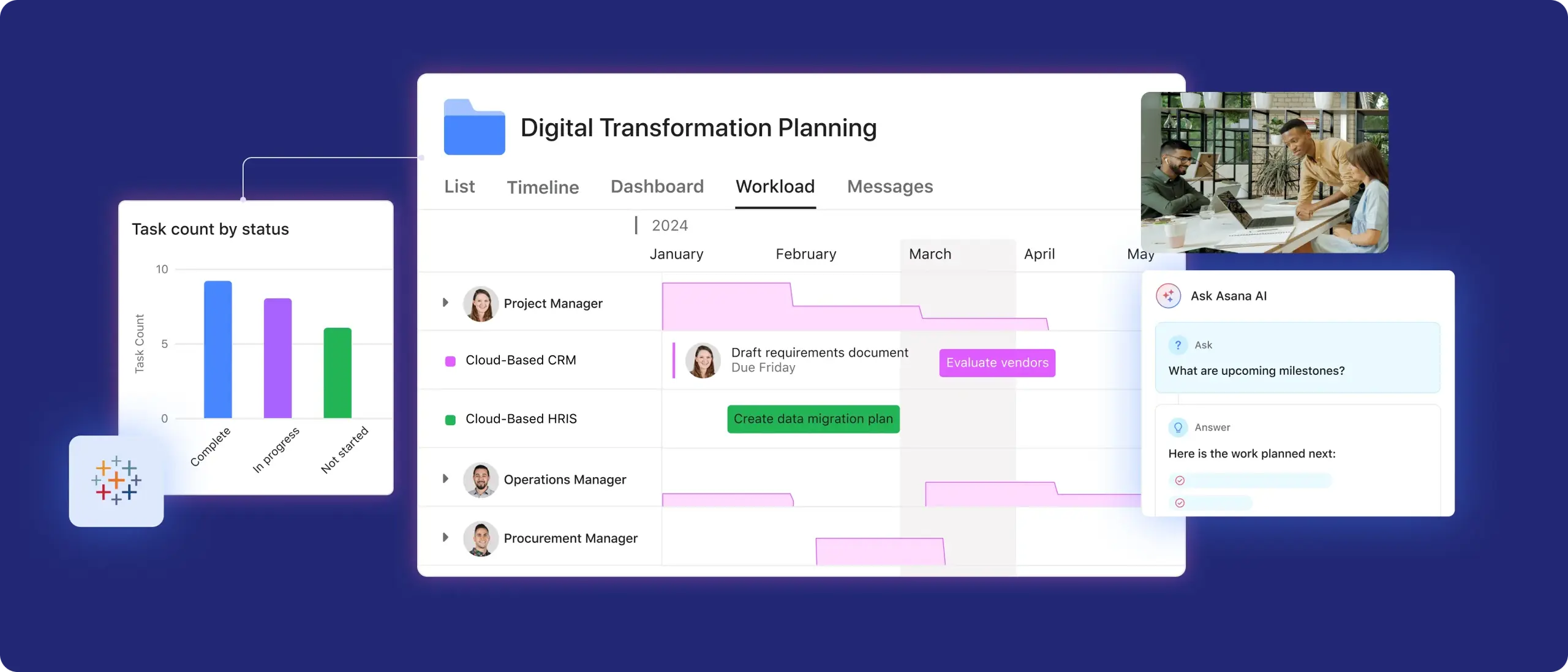
Make sure your team (especially senior leadership) has access to the strategic plan, so they can understand how their work contributes to company priorities and the overall strategy map. We recommend sharing your plan in the same tool you use to manage and track work, so you can more easily connect high-level objectives to daily work. If you don't already, consider using a work management platform.
A few tips to make sure your plan will be executed without a hitch:
Communicate clearly to your entire organization throughout the implementation process, to ensure all team members understand the strategic plan and how to implement it effectively.
Define what "success" looks like by mapping your strategic plan to key performance indicators.
Ensure that the actions outlined in the strategic plan are incorporated into the organization's daily operations, so that every team member's daily activities align with the broader strategic objectives.
Utilize tools and software, like a work management platform, that can aid in implementing and tracking the progress of your plan.
Regularly monitor and share progress on the strategic plan with the entire organization to keep everyone informed and reinforce its importance.
Establish regular check-ins to monitor the progress of your strategic plan and make adjustments as needed.
Once you've created and implemented your new strategic plan, the final step in the planning process is to monitor and manage it.
Remember, your strategic plan isn't set in stone. You'll need to revisit and update the plan if your company changes directions or makes new investments. As new market opportunities and threats come up, you'll likely want to tweak your strategic plan.
Make sure to review your plan regularly, meaning quarterly and annually, to ensure it's still aligned with your organization's vision and goals. Keep in mind that your plan won't last forever, even if you do update it frequently. When you've achieved most of your strategic goals, or if your strategy has evolved significantly since you first made your plan, it might be time to create a new one.
To turn your company strategy into a plan, and ultimately, affect, make sure you're connecting company objectives to daily work. When you clarify this connection, you're giving your team members the context they need to do their best work.
A work management platform plays a pivotal role in this process, acting as a central hub for your strategic plan. Here's how it helps:
Creates visibility: Every task and project ties directly to broader company goals
Improves coordination: Team members see how their individual efforts contribute to company success
Streamlines workflows: Aligns daily actions with strategic objectives to drive greater impact
Get started with Asana today to connect your strategic plan to everyday work.
Get our free ebook and learn how to bridge the gap between mission, strategic goals, and work at your organization.