Pareto principle 80/20 rule: prioritize for teams

85% of Fortune 100 companies choose Asana¹






Summary
When you get into the office in the morning, what's the first thing you do? Most people grab their caffeinated beverage of choice, check their email, and prioritize their tasks for the day. But what techniques do you use to identify what needs to get done first?
One common technique is called the Pareto principle, also known as the 80/20 rule. This technique can help you determine and prioritize your highest-impact tasks, increasing your productivity throughout the day. Below, we'll explore the Pareto principle, see real-world examples in action, and learn how to apply it to your work for better focus and results.
How to build a transformational AI strategy from the ground up
The journey of AI adoption is no longer uncharted territory. Supported by research from our Work Innovation Lab in partnership with frontier AI safety and research company, Anthropic, this guide offers a how-to for navigating the journey of AI adoption.
What is the Pareto principle?
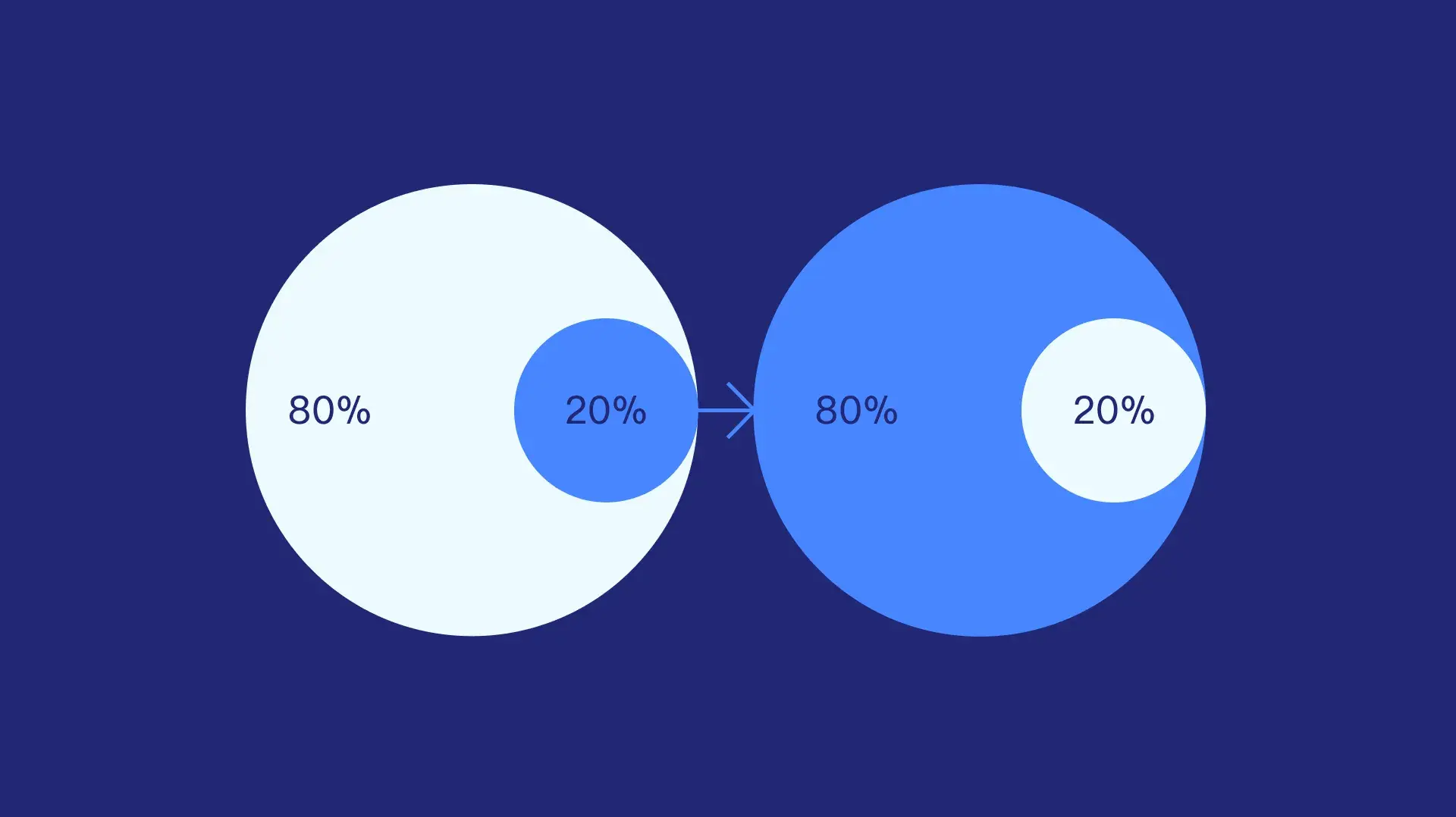
The Pareto principle, also known as the 80/20 rule, states that roughly 80% of outcomes come from 20% of causes. A small percentage of inputs creates the majority of results. Understanding this imbalance helps you identify which initiatives to prioritize for maximum impact. This phenomenon also goes by a couple of different names:
Pareto principle
The 80/20 rule (most common)
Law of the vital few
Principle of factor sparsity
The 80/20 rule is not a formal mathematical equation but rather a general phenomenon observed in economics, business, time management, and even sports.
Modern organizations, often called "Frontier Firms," are putting the Pareto Principle into practice by focusing on the 20% of work that delivers 80% of outcomes. AI makes this approach not only possible but increasingly practical for teams seeking to maximize impact.
Examples of the Pareto principle
The 80/20 rule shows up in many areas of business and life. Once you start looking for it, you'll see it everywhere. The key is that the inputs and outputs are unbalanced; a small number of causes account for the majority of the results.
Here are a few common examples:
Business:80% of a company's profits come from 20% of its customers.
Software development: 80% of software crashes are caused by 20% of the reported bugs.
Productivity: 80% of your results come from 20% of your tasks.
Sales: 80% of a company's revenue is generated by 20% of its sales team.
Agriculture: 20% of a plant contains 80% of the fruit.
Sports: 20% of players account for 80% of the points scored.
Understanding these patterns can help you identify where to focus your efforts for the greatest return, whether you're managing a team, improving a product, or planning your day.
Where does the Pareto principle come from?
How you can use the 80/20 rule
While the 80/20 rule applies across industries, it's especially valuable in business and economics for determining where to focus efforts. If your work can be segmented into smaller portions, the Pareto principle helps you identify which parts are most influential.
Here are a few ways to apply it in practice.
Productivity
You can use the 80/20 rule to prioritize the tasks that you need to get done during the day. The idea is that out of your entire task list, completing 20% of those tasks will result in 80% of the impact you can create for that day. To get the most done, identify which tasks have the greatest impact on your team and focus on them.
Research in decision science suggests that learning to identify the most productive projects and tasks, the vital 20%, can help professionals reclaim their time and reduce decision fatigue.
To apply the 80/20 rule to your daily tasks, start by listing everything you need to accomplish. Then identify your highest-impact items by asking:
Collaboration dependencies: Do any tasks involve teammates who are waiting on you?
Blockers: Are any tasks holding up project progress?
Downstream impact: Will completing certain tasks unlock work for others?
These tasks may be simple to complete, but they can make a large impact by keeping work flowing.
Read: How to be more productive: 13 tips to practice todayDecision making
The Pareto principle can strengthen your decision-making process when solving complex problems. When there are many causes of a single problem, the Pareto principle can help you prioritize solutions. Here are a few steps on how this works:
Identify the problems that your team is experiencing. These are the problems you're trying to solve in this decision-making process.
Identify the causes of these problems. Using a tool like the 5 Whys process, find all of the causes of the problems you're trying to solve.
Categorize your problems into similar groups. If some of the causes of the problems you're trying to solve can fall into similar categories, use this as an opportunity to group them together. This can help you decide whether a single solution can resolve multiple issues.
Use data-driven decision-making to assign a value to each of these problems based on the impact on the business. The value can be as simple as a number between 1-10, or actual monetary value to indicate the importance.
Develop a plan to focus on the top 20% of problems affecting the business. The idea is that one solution can resolve multiple problems. Based on the values you assigned to each problem, calculate which ones are in the top 20%. Once you've identified the main problem, develop a plan to create a solution that can result in 80% of the results using problem-solving strategies.
Quality control
The Pareto analysis and the Pareto chart are key tools used within the Six Sigma quality control methodology. In Six Sigma, a Pareto chart helps you visualize data and prioritize actions. Since Six Sigma aims to reduce process variation and increase production, Pareto charts are ideal for quickly identifying the factors that drive the most variation.
Example of how to use the 80/20 rule for decision-making
Imagine you work at an e-commerce company. You review 100 of your most recent customer service complaints and notice that most come from customers who received damaged products. Your team calculates that approximately 80% of the refunds given were for damaged products.
Your company wants to avoid processing refunds for broken products, so you make this problem a priority solution. Your team decides to update the packaging to protect your products during shipping, resolving the issue.
Create a prioritization matrix templateBenefits of using the Pareto principle
The biggest advantage of the Pareto principle is creating maximum impact with focused effort. By prioritizing initiatives in the right order, your team can work more efficiently and improve metrics faster.
Key benefits include:
Clear priorities: Both you and your team know what matters most.
Increased productivity: Focus on high-value tasks drives better daily output.
Manageable workloads: Break large projects into prioritized segments.
Focused strategy: Align efforts with goals that move the needle.
Disadvantages of using the 80/20 rule
A common misinterpretation is that 20% effort yields 80% of results. In reality, the numbers refer to causes and consequences, not effort levels. You still need to put 100% effort into the right 20% of work to achieve 80% of results.
Another downside is that team members can become too focused on high-priority tasks and lose sight of smaller responsibilities. Important but less urgent tasks, like email and correspondence, can slip through the cracks.
The challenge is finding balance. To manage both high-impact work and routine tasks, try techniques like timeboxing or the Getting Things Done (GTD) method.
Put the 80/20 rule into action with Asana
Finding different ways to help your team achieve productivity is an important part of being a team leader. Using a work management tool like Asana can help you organize all your team projects and tasks, share files, leave comments, and provide feedback in one location, saving you time.
When you apply the Pareto principle to your work, you can quickly identify which 20% of your tasks will drive 80% of your results. Asana helps you visualize priorities, connect daily tasks to larger goals, and help your team stay focused on high-impact work. Get started and see how Asana can help your team work smarter.
Create a prioritization matrix templateFrequently asked questions about the Pareto principle
This is a common observation that reflects the Pareto principle; a small group of high performers often drives the majority of results. Recognizing this helps leaders empower top contributors and identify growth opportunities for others.
No, this is a common misconception. The numbers represent different units (causes vs. outcomes), so you might see 80% of results from 30% of causes; the key insight is the imbalance, not the specific figures.
Yes, the principle works well for personal productivity. Use it alongside a priority matrix to identify the few tasks on your to-do list that deliver the most significant results, whether for work goals, learning, or daily priorities.
A Pareto chart combines a bar chart (showing factors by frequency) with a cumulative line graph. Use it in quality control or project management to quickly identify which problems or causes have the greatest impact.