Is your business requirements document guiding decisions?


85 % der Fortune-100-Unternehmen entscheiden sich für Asana¹






Asana’s State of Work Innovation research found that 83% of workers said slow approval processes sometimes delayed their work. Preparing a project for review starts with giving stakeholders the information they need to make decisions.
A business requirements document brings a project’s goals, scope, and requirements into one report. A BRD template gives you a starting point for gathering stakeholder input and preparing requirements for approval. For each requirement, state what the business needs, how the team will verify it after delivery, and what work is needed to fulfill it.
What is a business requirements document (BRD)?
A business requirements document (BRD) formally records a project’s business needs, objectives, scope, and requirements. It answers three core questions: what the organization needs, why the project is worth pursuing, and how to measure success. It helps stakeholders agree on what the project needs to achieve and gives the team a reference for decisions as work progresses.
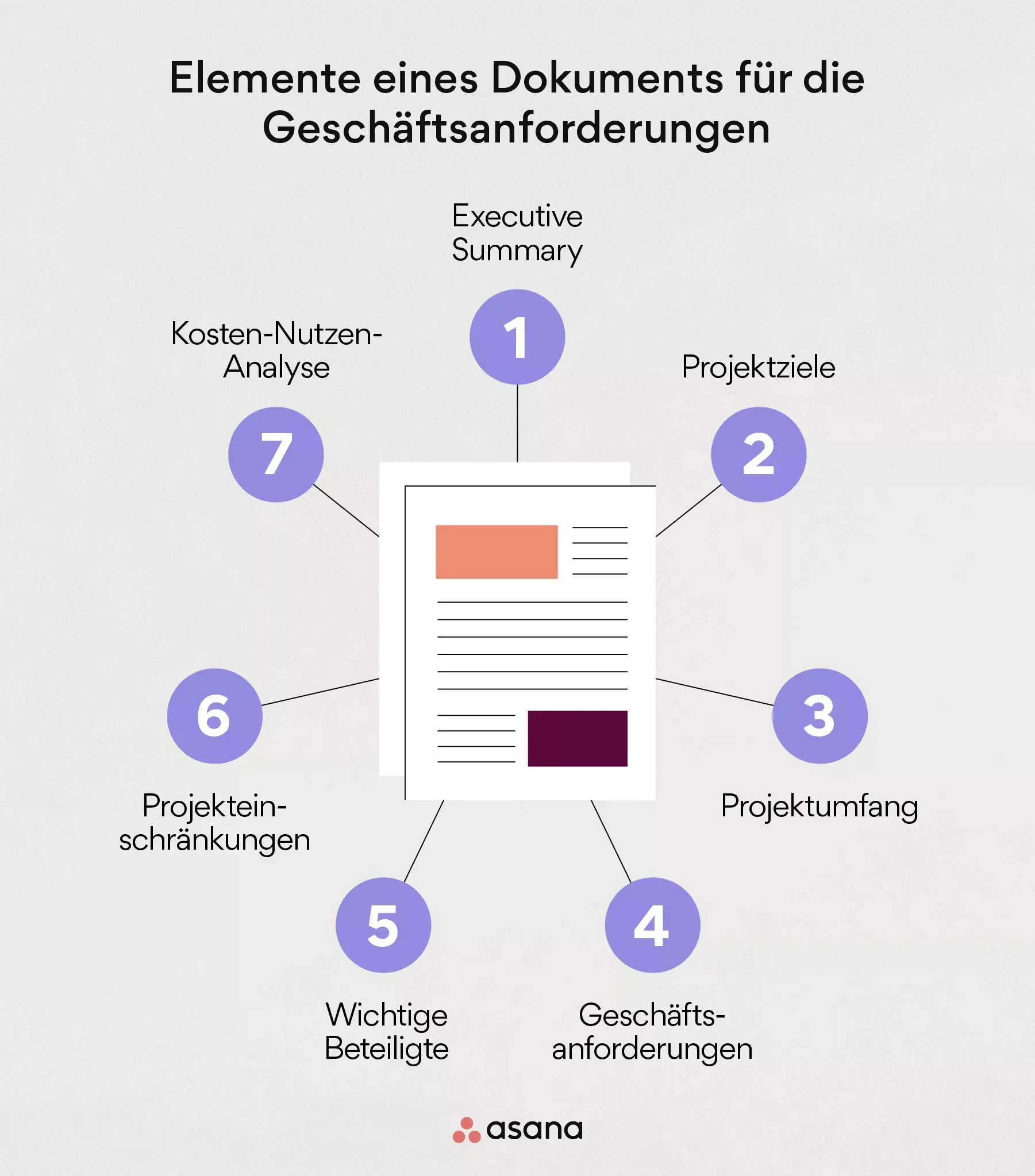
The seven components of a BRD are:
By outlining each of these sections, anyone who reads your business requirements document should clearly understand what your project is, what you hope to achieve, and how you plan to achieve it.
Why use a business requirements document template?
A business requirements document template gives you a consistent structure for gathering project information. Documenting assumptions, task owners, and decisions helps reviewers spot gaps and ask useful questions. Here’s how that structure supports your team:
Stakeholder alignment: Define the project’s boundaries and objectives so contributors can review the same goals.
Scope control: Document what is in and out of the project scope, then use that agreement to assess requests through your change control process.
Time savings: Start with a reusable BRD template instead of building a new document for every project.
Informed approvals: Give executives and clients the business purpose, success milestones, and details they need to review your plans.
Business requirements document template (and example)
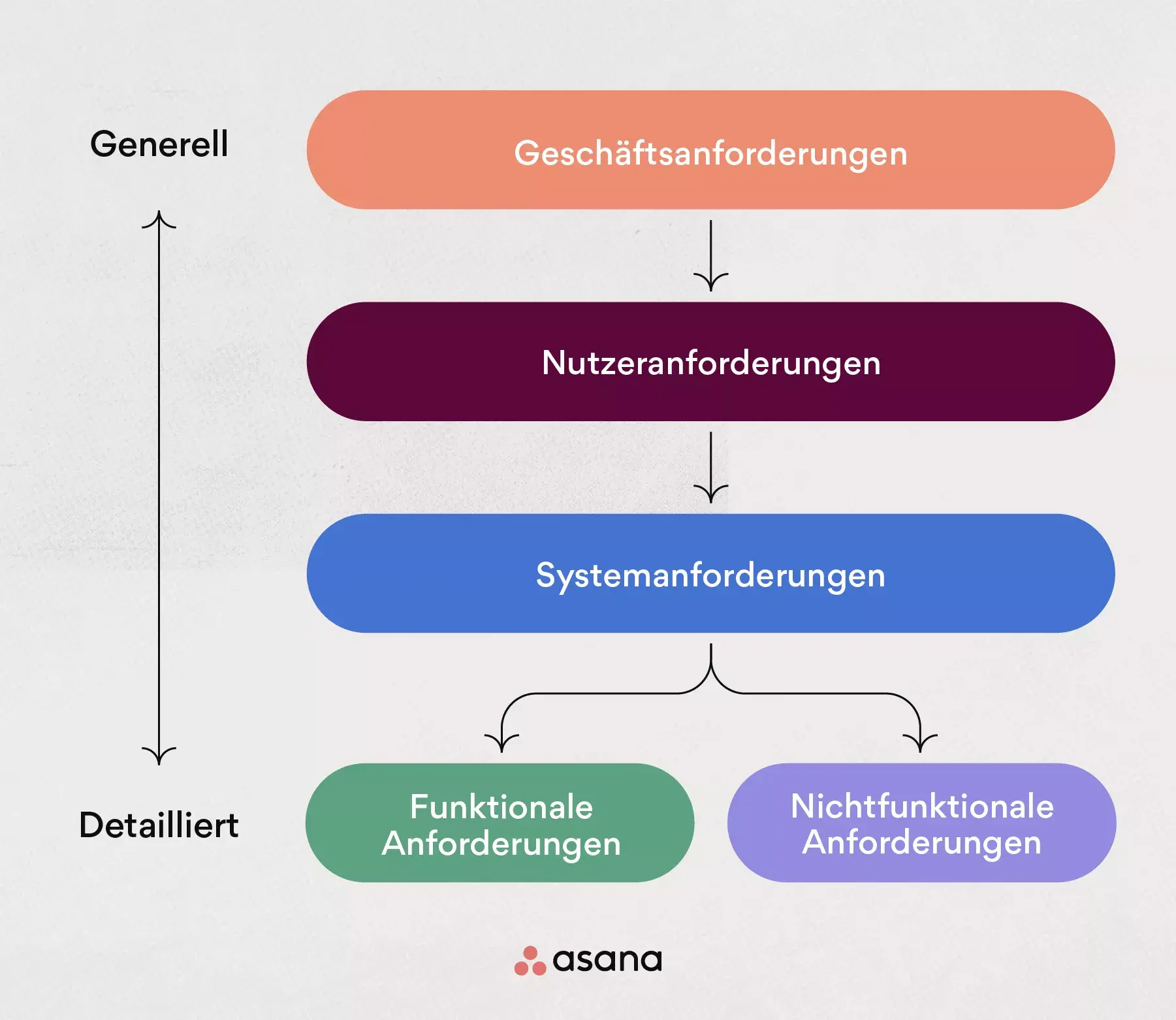
Start with our free two-page BRD template. It includes space for the seven sections below, so you can gather the project’s purpose, requirements, and supporting details in one document.
Use this additional record for requirements that need individual review. Copy it into your document or an Asana task description, then repeat it for each requirement. Keep the ID the same through revisions and update the version separately.
Field | Your requirement |
Requirement ID and version | [ID] — [version] |
Business need and source | [What the business needs, why it matters, and who requested it] |
Requirement statement | [One result or capability the business needs] |
Priority and scope | [Priority and reason; what is included and excluded] |
Verification and evidence | [How you’ll check the requirement; where you’ll keep the evidence] |
Owner and approver | [Who maintains the requirement; who approves it] |
Dependencies and assumptions | [What you depend on; what still needs to be confirmed] |
Decision and change history | [Status, decision date, reason, and affected work] |
Write a BRD your team can act on
Let’s put the BRD template to use. In this illustrative example, a technology company plans to launch a marketing blog in six weeks. Maya, the marketing project manager, writes the BRD with Leo, the content lead, and Nina, the marketing operations approver.
1. Agree on the business need, scope, and measure
Start by asking the sponsor and contributors what the blog needs to achieve, what’s outside the project scope, and who will review the requirements. Agree on how you’ll measure results, too.
In Asana and Meltwater's 2024 State of Marketing Collaboration research, only 30% of surveyed marketing professionals said they were highly familiar with their organization’s measurement plans. Naming a target is one step; your team also needs to know who tracks it, which data they use, and when they’ll review it.
Maya gathers that information before completing the seven sections:
BRD component | Marketing blog example |
Executive summary | Launch a blog to attract prospective customers and measure its contribution to qualified leads. Request approval for the initial English-language launch. |
Project objectives | Target 20 qualified blog-generated leads per month by the third month after launch. Nina will track the results in the existing CRM. |
Project scope | Launch an English-language blog in the existing CMS. Translated posts are outside the initial scope. |
Business requirements | Attribute blog leads, approve posts before publication, and report results monthly. |
Key stakeholders | Maya manages the project, Leo leads content, and Nina reviews the marketing operations requirements. |
Project constraints | Launch in six weeks using the existing CMS. Confirm that reviewers have enough time to support the schedule. |
Cost-benefit analysis | Estimate the effort for content, CMS setup, tracking, and review. Compare those costs with expected lead-generation and reporting benefits before approving the investment. |
The 20-lead figure is this BRD example’s business target. The team will measure results after launch.
2. Write business requirements for review and approval
Write one requirement at a time, then decide how the team will check it. Maya turns “Attribute blog leads” into a more specific statement: “Attribute blog-generated leads in the CRM so marketing can measure contribution.”
Maya proposes a test: after delivery, the team will submit ten forms and confirm that each CRM record retains its blog source. This will show whether attribution works; Nina will assess the separate 20-lead target after launch.
Here’s how Maya fills out the requirement record while BR-01 is in review:
Field | BR-01 in review |
Requirement ID and version | BR-01, version 2 |
Business need and source | Marketing needs to measure the blog’s contribution to qualified leads. Nina supplies the measurement requirements. |
Requirement statement | Attribute blog-generated leads in the CRM so marketing can measure contribution. |
Priority and scope | Must have for the English-language launch. Translated posts are excluded. |
Verification and evidence | Ten test submissions retain the blog source in the CRM. Attach the test checklist and later results to BR-01. |
Owner and approver | Maya maintains the requirement; Nina reviews and approves it. |
Dependencies and assumptions | Depends on configuring the form-to-CRM connection. Confirm access to the CRM and reviewer availability. |
Decision and change history | In review. Nina requested the verification system; Maya added the CRM and test checklist in version 2. Record Nina’s decision and date after review. |
Maya also assigns priorities to the other requirements:
Requirement | Owner | Priority |
BR-01: Attribute blog leads | Maya | Must have |
BR-02: Approve posts before publication | Leo | Must have |
BR-03: Report results monthly | Nina | Should have |
Lead attribution and publication approval are needed for the initial launch. Monthly reporting follows once the blog is live, so the team gives it a lower launch priority while keeping an owner responsible for it.
3. Move from requirements to workflow in Asana
Open the Asana BRD template and adapt it to your project. Create a task for each requirement, include its ID in the task name, and assign one owner. Add custom fields for Priority and Review status, then put the requirement statement in the task description and explain how the team will verify it.
These are fields and example requirements you add when adapting the template. Keep delivery tasks connected to the requirement they support: “Configure the lead-source field,” for example, is work needed to fulfill BR-01.

4. Review the requirement and record the decision
Before requesting approval, check that each record states one requirement, its business purpose, how the team will verify it, and who owns and approves it. Include assumptions, exclusions, and a place for evidence so the reviewer can assess the version in front of them.
Maya assigns Nina a review task for BR-01. Nina asks which system will verify attribution, so Maya names the CRM and attaches a test checklist. The revised requirement is now ready for Nina’s decision.

In this example, Nina approves the proposed wording and verification method, and Maya records the approved version and decision date. The team will test the delivered work later, then review lead performance after launch.
Asana approval tasks offer Approve, Request changes, and Reject. A custom Review status field helps you track progress; it doesn’t set approval permissions or prevent work from proceeding.
When a request arrives to add translated posts, Maya records it as CR-01 and checks its effect on the six-week deadline and review capacity. The sponsor defers the request to a later phase. Maya keeps the English-language scope and links the decision to the affected work, so the team knows what to deliver now.
What should a business requirements document include?
Your business requirements document should give readers enough detail to assess the project. Use these seven components as a starting structure, then add version, approval, or supporting-evidence fields when your team needs them.
Many people may read a BRD, including project stakeholders, executives you need approval from, and clients influenced by the end results. Learn more about each component to include in your template below.
1. Executive summary
The executive summary is a high-level statement outlining what your project is and its purpose. Those who don't have time to read the BRD in its entirety should understand what you plan to accomplish by reading your executive summary.
Write the executive summary after the other sections. You can then draw on the completed document to summarize the business problem, proposed change, and decision you’re asking stakeholders to make.
Lesenswert: So schreiben Sie ein Executive Summary – mit Beispielen2. Project objectives
Your project objectives are the business goals you want to achieve by putting your project into action. It's important to state your project objectives before kicking off any work so you can use them to measure your progress.
List your project objectives as SMART goals to ensure that they're:
Specific
Measurable
Achievable
Relevant
Time-specific
For the marketing blog, Nina will measure the target of 20 qualified leads per month in the CRM by the third month after launch. If results fall short, the team can review its work and decide what to adjust. Testing BR-01’s attribution check tells them whether leads are recorded correctly; tracking the objective tells them whether the blog is contributing the intended results.
3. Project scope
Your project scope sets the boundaries of the work. Record those boundaries in a scope management plan, so the team has a shared reference for new requests. This helps you manage scope creep, when work expands beyond what was agreed.
Details to outline in your project scope include:
Project team
List what is excluded, too. For the blog launch, translated posts are outside the initial scope. When that request arrives later, Maya can assess its effect on the deadline and ask the sponsor to decide whether to change the plan.
4. Business requirements
Business requirements describe the results or capabilities the business needs to achieve its objective. Write each requirement separately and connect it to the need it serves. Keep the delivery tasks linked to that requirement so readers can distinguish what is needed from the work required to provide it.
Give each requirement an ID, priority, owner, and a way to verify it. Explain why the priority matters to the agreed scope, and keep the ID the same through revisions so reviewers can follow its decisions and changes.
For example, BR-01 lets the marketing team measure the blog’s contribution to leads. Configuring a CRM field is a delivery task that supports that requirement. The planned test with ten submissions tells reviewers how the team will verify attribution.
5. Key stakeholders
Project stakeholders include anyone with an interest in your project. These are likely the people who will read your BRD template to understand what the project is about. Your key stakeholders may be:
Team members working on the project
Project managers leading the project
Executives approving the project
Clients influenced by the finished project
List each stakeholder’s name, role, and responsibilities. Identify who maintains each requirement, who contributes expertise, and who approves it. In the blog example, Maya owns BR-01, Leo contributes content knowledge, and Nina reviews the measurement requirement.
An Asana survey found that companies reporting higher performance tended to use coordination for information transfer, handoffs, and project planning. For your BRD, put that idea into practice by agreeing on who contributes information, who maintains the document, and who makes the decision.
Lesenswert: Was ist eine Analyse der Projektbeteiligten und warum ist sie wichtig?
6. Project constraints
You likely presented an overview of your project constraints within your project scope, but here, you'll explain these boundaries in more detail. When the reader reviews this section, they should see the project's shape and its limits.
Review these limits and related planning elements:
Team availability
Deadlines
Project budget
Distinguish fixed limits from things you still need to investigate. The blog’s six-week deadline and existing CMS are constraints. A dependency is work the project relies on, such as configuring the form-to-CRM connection. Maya needs to confirm reviewer availability; insufficient capacity could delay the schedule.
7. Cost-benefit analysis
A cost-benefit analysis helps stakeholders compare the estimated investment with the expected benefits. Those benefits may include revenue, time savings, fewer errors, or reduced risk. Explain your assumptions so reviewers can assess whether the expected value justifies the effort and cost.
To create a cost-benefit analysis:
Describe all the costs associated with your project
Explain the associated benefits
Write the total expected cost of your project
Compare estimated costs and benefits over the same period. If both are expressed in money, subtract costs from benefits to estimate the net benefit.
What is the difference between business requirements and functional requirements?
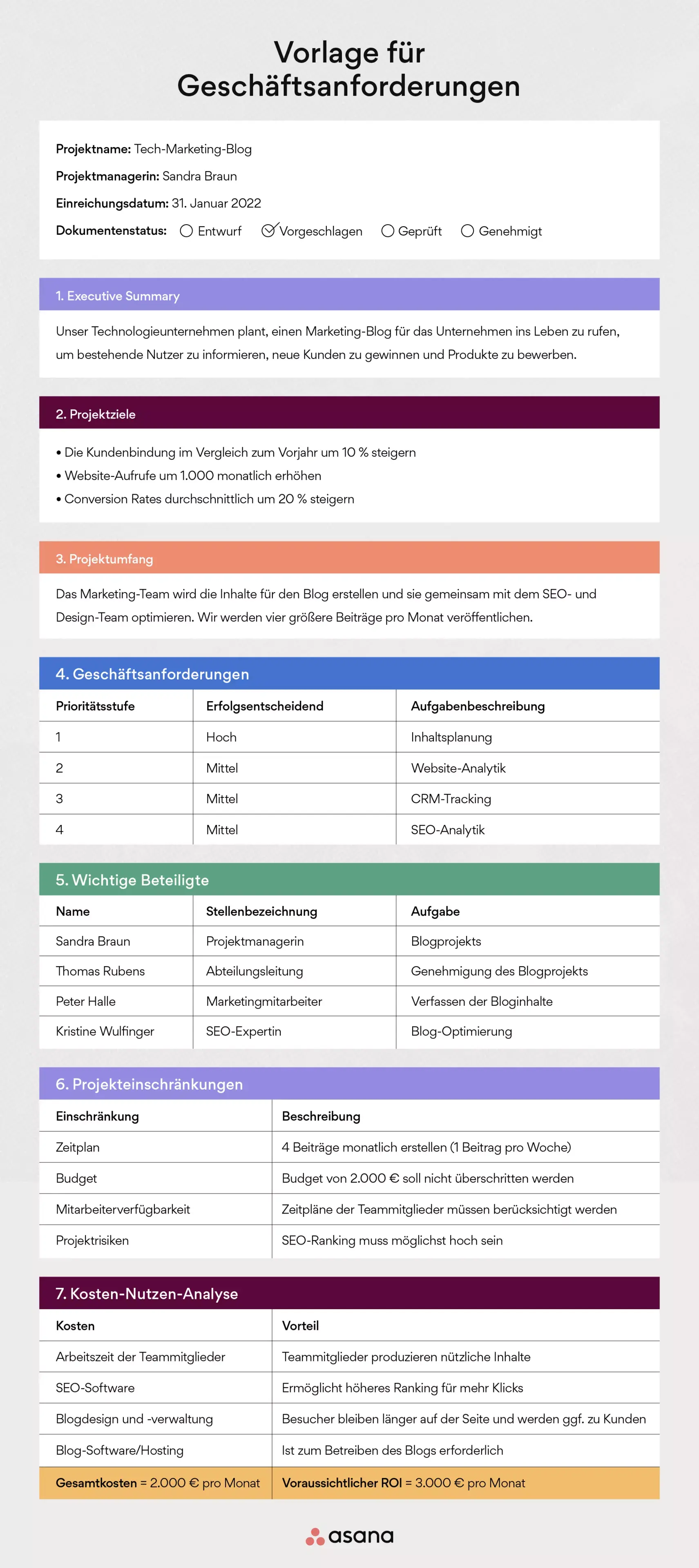
Business requirements explain what the business needs to achieve. Functional requirements describe the behavior a solution must support to meet that need. Teams can develop and review both as they learn more about the project.
For the blog, the business needs to measure its contribution to qualified leads. A supporting functional requirement is to retain the blog-source value when a form submission creates a CRM record. Configuring and testing that field is the delivery task.
Business requirements document (BRD) | Functional requirements document (FRD) |
Explains what the project needs to achieve | Describes behavior the solution must support |
High-level overview for stakeholders | Detailed descriptions of required behavior |
Focuses on business goals and scope | Focuses on system behavior and functionality |
Created early in project planning | Developed from business needs and refined through review |
Besides functional requirements, there are:
User requirements: These describe what users need to accomplish with the finished solution.
Product requirements: These describe the product’s purpose, features, and expected behavior.
Non-functional requirements: These specify the solution's qualities, such as performance, reliability, accessibility, or security.
Draft your BRD with AI
AI can help you prepare a draft for stakeholders to review. At Indeed, Analytics teams use AI Studio to draft project charters and technical requirements in comments. Senior technical program managers then validate the scope.
For the blog example, Maya could supply the agreed request and project context with this instruction: “Use only the supplied context. Draft the business need and requirements, and list missing facts as open questions. Do not invent targets or approve the draft.” Maya would then check every statement before stakeholder review.
To use this approach in AI Studio, configure the workflow and an output action, such as adding a comment, following the AI Studio instructions.
How DIRECTV and loanDepot connect business requirements
Once your team agrees on its requirements, it needs a way to carry those decisions into delivery. These customer examples show practices you can adapt when putting your BRD into action.
DIRECTV: Check requests against business priorities
DIRECTV uses centralized intake and standard request forms across more than 20 teams. Requests connect to the company’s Internal Operating Priorities, and a steering process uses voting to prioritize and approve initiatives.
Apply that approach to your BRD by recording which business priority a requirement supports and why it belongs in the approved scope. When a new request arrives, reviewers can compare it with the same priorities.
Read the DIRECTV success story →
loanDepot: Keep approval records with the work
loanDepot’s HR Technology team replaced email and verbal approvals with templated request tasks. For a Workday security-group request, the team keeps notes, screenshots, subtasks, and records of approval, configuration, and production in one place.
Keep the same connection between your BRD decisions and deliverables. Attach the approved requirement, review comments, and supporting evidence to the related task so teammates can find what was decided and why.
Read the loanDepot success story →
Give every business requirement an owner and a next step
Once your BRD is approved, connect each requirement to the person responsible and the work needed to deliver it. Keep later changes and review decisions alongside that work so your team can act on the agreement.
Use the Asana business requirements document template to organize requirements, assign owners, and keep related tasks and decisions together as your project progresses.
Kostenlose Vorlage für GeschäftsanforderungenFAQs about business requirements documents
To write a business requirements document, work from the business need to the requirements stakeholders can review and the work your team will deliver:
Gather input. Ask stakeholders what the business needs, why the project matters, and who will approve its scope.
Define the boundaries. State the project’s objectives, what is included and excluded, and any constraints or dependencies.
Draft the seven sections. Cover the executive summary, objectives, scope, business requirements, stakeholders, constraints, and cost-benefit analysis.
Make each requirement reviewable. Assign each a unique ID, priority, and owner. Explain how the team will verify it after delivery and where the evidence will be recorded.
Review and record the decision. Resolve stakeholder questions, document changes, and save the approved version. Then connect each requirement to the work needed to deliver it.
In der Regel wird das BRD von einem Business-Analysten verfasst, wobei es sich jedoch um eine gemeinsame Aufgabe handelt, an der Projektmanager, Subject Matter Experts und wichtige Beteiligte mitwirken.
Die vier Arten sind Geschäftsanforderungen (übergeordnete Ziele), Stakeholder-Anforderungen (Benutzerbedürfnisse), Lösungsanforderungen (funktionale und nicht-funktionale Spezifikationen) und Übergangsanforderungen (Implementierungsbedürfnisse).
Sie sollten ein BRD gleich zu Beginn eines Projekts, während der Planungsphase, erstellen. Es sollte fertiggestellt sein, bevor mit der Entwicklung oder der Ausführung begonnen wird, um sicherzustellen, dass alle Beteiligten über die Ziele und den Umfang des Projekts informiert sind.
Es gibt keine festgelegte Länge; ein BRD sollte so lang sein, wie es erforderlich ist, um Ihre Anforderungen klar zu kommunizieren. Kleinere Projekte benötigen vielleicht nur wenige Seiten, während komplexe Vorhaben mehr Details erfordern.