Transform feedback into results with a stakeholder engagement plan template


85% perusahaan Fortune 100 memilih Asana¹






Summary
A stakeholder engagement plan template gives your team one place to record what people need from a project, when you’ll ask for input, and who will follow up. It helps you plan those conversations alongside the rest of your project workflow.
You’ll learn how to map stakeholders, choose communication methods, and respond to feedback. Copy the blank plan to get started, then see how a project team uses it to resolve a training issue.
What is a stakeholder engagement plan?
A stakeholder engagement plan (SEP) identifies your project stakeholders, assesses their influence and interest, and outlines how you’ll work with them throughout the project. It records what input you need, who makes decisions, and how your team will respond to concerns.
Stakeholders can be either individuals within your team or external parties affected by your work.
Internal stakeholders may include project managers, operations teams, department heads, and board members.
External stakeholders may include clients, customers, investors, suppliers, company partners, or shareholders.
Because communication with stakeholders begins right at the start of a project, you'll create your engagement plan during the project planning phase. Once you have an idea for a project, identify who your stakeholders are and how involved they need (or want) to be. As the project progresses, you can adjust your SEP to meet their needs.
How to use a stakeholder engagement plan
Use a stakeholder register to document who is involved in your project. Your engagement plan explains how those people will contribute and how your team will address their input and feedback. A communication plan sets out what information you’ll share, when you’ll share it, and who is responsible for sharing it.
Align expectations with stakeholders by clarifying required input, its importance, response deadlines, and how decisions will be confirmed. Determine each person’s preferred communication style, such as meetings, written updates, or self-service access to project information.
In the Work Innovation Lab’s guide to high-value collaboration, Carlos Valdes-Dapena describes having teams agree on how they will work together. Methods include making specific requests, confirming agreements in writing, and giving people time to amend them. Use that approach to agree on how stakeholders will contribute before asking them to act.
Maintain the engagement plan within your project team to allow updates as needs change. Use work management software to assign follow-up tasks and share communication arrangements, while keeping private stakeholder assessments confidential.
Stakeholder engagement plan template
Copy this blank plan into your project document. Add your project’s name, purpose, and review date, then repeat the stakeholder fields for each person or group. Create a follow-up entry for every concern or decision that needs action. The completed example after the five steps shows how the plan works in practice.
Templat gratis rencana keterlibatan pemangku kepentinganBlank stakeholder engagement plan
Project: ___. Purpose: ___. Review date: ___.
Field | Copy-and-paste entry |
Stakeholder and role | Name or group: ___. Role: ___. Internal or external: ___. |
Interest, influence, and support | Interest: ___. Influence: ___. Current support/involvement: ___. Involvement needed: ___. |
Input or decision needed | Question: ___. What can change: ___. Response needed by: ___. |
Owner and decision maker | Engagement owner: ___. Person who decides: ___. |
Method and timing | Channel: ___. Update frequency or milestone: ___. Next contact: ___. |
Concern or feedback | What was heard: ___. Date: ___. Relevant notes or source: ___. |
Decision and follow-up | Decision and reason: ___. Action: ___. Assignee: ___. Due date: ___. |
Response and review | Who will report back: ___. When: ___. Response sent: ___. Next review: ___. |
Keep private assessments of influence and support in a separate record for the project team. Share the communication arrangements, decisions, and next steps with the stakeholders involved.
What to include in a stakeholder engagement plan
Provide sufficient detail to identify contributors and outline subsequent actions:
Stakeholder name and role: Record each person or group in a stakeholder register.
Interest, influence, and support: Interest describes how much attention someone gives the project. Influence describes their ability to affect decisions. Support describes their current response to the project or a proposed change. Record these separately.
Input needed: Write the question you need answered, what the person can help change, and when you need a response. Note how they need to be involved.
People responsible: Name the person managing the relationship and the person who can make the decision.
Method and timing: Choose a communication tool, the information to share, and a useful update schedule or milestone.
Follow-up: Record concerns, decisions, assigned actions, due dates, and who will report back.
5 steps to create a stakeholder engagement plan
To create an effective stakeholder engagement plan, first understand stakeholder needs and their influence on your project. Follow the steps below to begin.

1. Identify your stakeholders
List the people who can affect the project and those it will affect. Include your team, decision makers, customers, and external partners. Ask your current contacts who else should be involved, especially people whose day-to-day work will change.
Record what each group needs from the project before choosing how to involve them. A person with little authority may still spot a problem that changes your plan.
5 levels of stakeholder engagement
Leading: A leading stakeholder is aware of the project's impact and is actively involved.
Supporting: A supporting stakeholder is aware of the project's impact and supports the project.
Neutral: A neutral stakeholder is aware of the project's impact but neither supports nor opposes it.
Resistant: A resistant stakeholder is aware of the project's impact but resists change.
Unaware: An unaware stakeholder is unaware of the project or its impact.
These labels describe someone’s current relationship to the project. They don’t measure interest or authority. A person can be highly interested and still resist a proposed change. Record how you need them to be involved next, and update your assessment based on what they tell you.
Next, consider their influence: how much they can affect project decisions or prompt others to act.
The scale of stakeholder influence
Very high: A stakeholder with very strong influence has significant control over key project decisions.
High: A stakeholder with high influence can cause others to take action.
Medium: A stakeholder with medium influence is often part of the decision-making process.
Low: A stakeholder with low influence has limited ability to change project decisions. Ask for their input when the work affects them, and explain how the team will respond.
Very low: A stakeholder with very low influence has little control over project decisions. They may still be affected by the outcome and need a way to raise concerns.
2. Map stakeholders on the influence/interest grid
Map each stakeholder by influence and interest, then use the grid to plan how you’ll involve them. Keep this assessment within the project team. Confirm each group’s needs and preferences before choosing channels or timing.
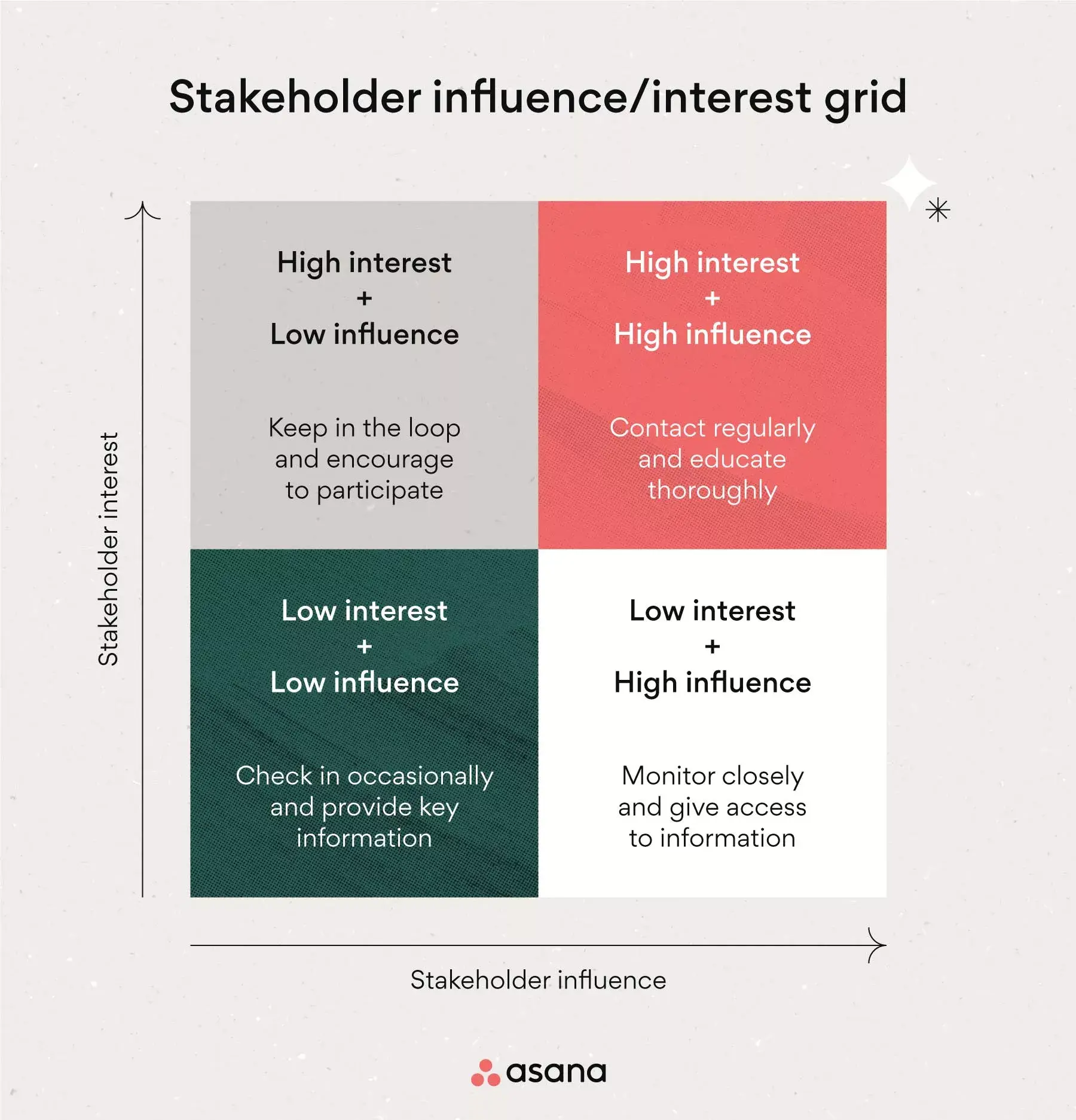
Once you've mapped your stakeholders, you'll see four distinct groups emerge:
Stakeholder Group | Characteristics | Engagement |
High interest, high influence | High attention to the project and substantial ability to affect decisions | Agree which decisions need their input and when they need updates |
High interest, low influence | High attention to the project, with limited control over decisions | Ask about practical effects, invite input, and report back on decisions |
Low interest, high influence | Less day-to-day interest, with substantial ability to affect decisions | Bring decisions and relevant changes to them when their input is needed |
Low interest, low influence | Less day-to-day interest and limited control over decisions | Agree a useful update schedule and give them a way to raise concerns |
Use a project management tool to share relevant updates and track responses. Revisit the grid when roles, needs, or decisions change.
Baca: Apa itu analisis pemangku kepentingan proyek dan mengapa itu penting?3. Build a communication plan
Use your stakeholder map to develop a communication plan for each group. Determine the information they need, the input required from them, and response deadlines.
Select an appropriate communication channel for each task. Decisions may require discussions or approvals, while progress updates may be best delivered in writing.
Assign responsibility for preparing each update or request and designate who will respond. Ensure relevant project information is accessible to those who need it.
Establish timing for decisions and milestones within your project timeline. Adjust the schedule if it no longer meets stakeholder needs.
Asana’s 2022 Meeting Reset experiment with 60 marketing participants found that 70% of the time saved came from changes other than canceling meetings. Those changes included adjusting attendance and moving parts of meetings to asynchronous communication. Consider whether a different format or a written update would serve your stakeholders better than another recurring meeting.
For example, a sponsor may prefer weekly status updates and separate requests for decisions. Confirm their preferences instead of relying solely on the grid’s suggested schedule.
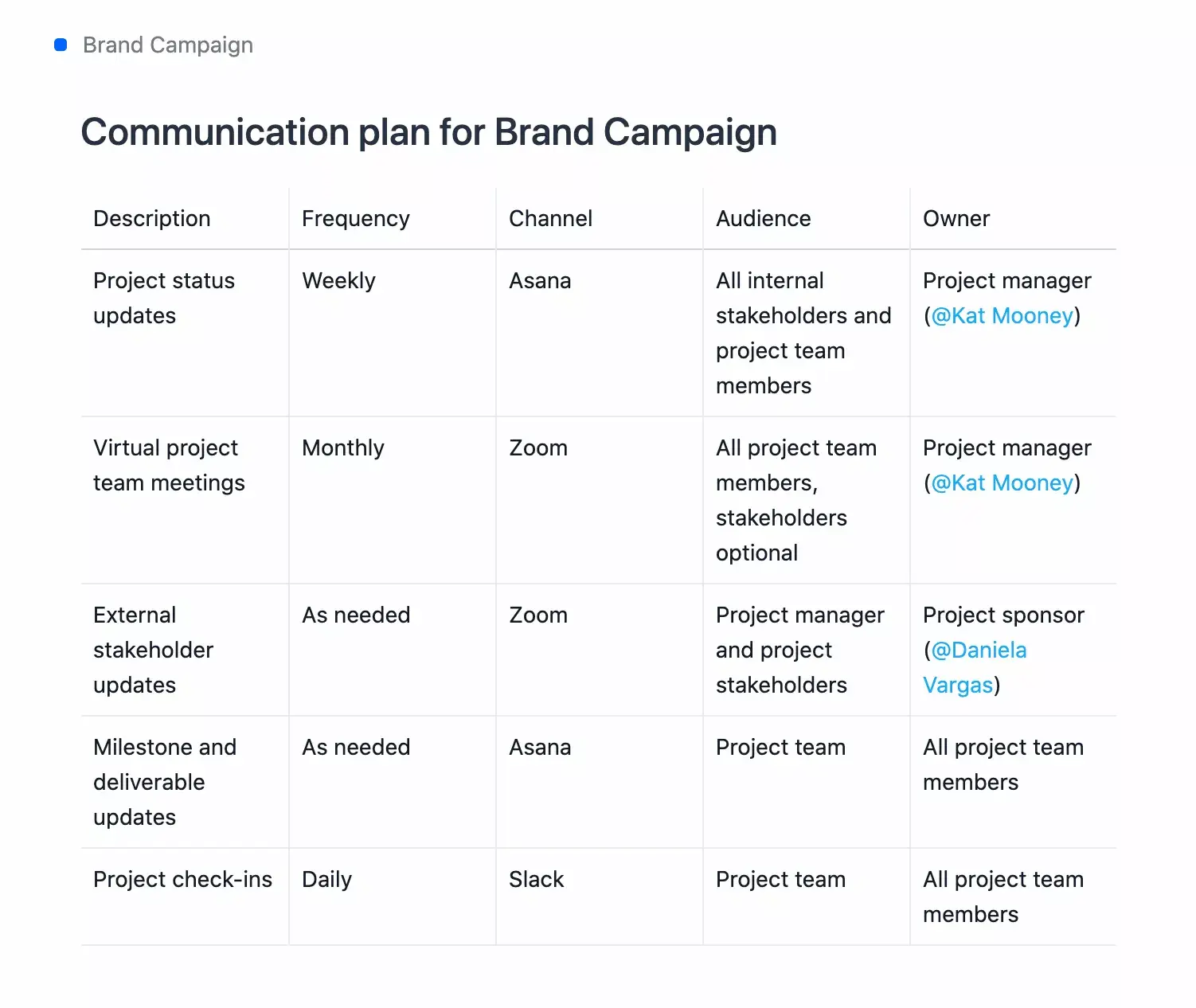
Once you create your communication plan, share it with your project team. If you change your communication plan, update it and communicate those changes. That way, team members always have access to the most up-to-date information.
4. Collect feedback and assign follow-up work
Ask stakeholders about specific decisions or practical concerns. For example, “Which part of this schedule would make it difficult for your team to take part?” provides a clear prompt for feedback.
Choose a way to collect feedback that works for the people involved. You can use a survey, written comments, a team discussion, or a video call. Share the communication plan and ask whether the channels and timing suit them.
For each concern, record what you heard, who can decide what to do, the next action, its owner, and its due date. If someone doesn’t respond, check the channel, timing, and opportunity to contribute before assuming they agree. Assign a person responsible for unresolved concerns.
5. Review decisions and update the plan
Check that the person responsible completed the agreed action. Tell stakeholders what changed, or explain why their request wasn’t adopted. Record when you’ll review the arrangement again. Update the plan at project milestones, when new people join, or when needs change. Keep a concern open until someone makes a decision, assigns work, and reports back to the people who raised it.
Stakeholder engagement plan example
In this stakeholder engagement plan example, a US company plans to launch a customer-support portal on November 16, 2026. Project lead Maya Chen works with operations sponsor Jordan Lee, support lead Leo Martinez, training lead Priya Shah, and IT lead Alex Kim.

The support team has high interest in the rollout but little formal control over it. Its representatives oppose the proposed training schedule because it would leave too few agents available to support customers. They want the schedule changed; they aren’t opposing the portal itself.
Stakeholder | Planned engagement |
Support team, represented by Leo | Maya asks which training times preserve service coverage. Input is due November 3. The team has high interest and low formal influence, and resists the proposed schedule. |
IT and implementation vendor | Alex reviews portal-access requirements with the vendor by November 4. They have high interest and high influence over technical readiness. |
Operations sponsor, Jordan | Jordan decides the training approach by November 4. He has high influence and needs to see the options and how each affects support coverage. |
Training lead, Priya | Priya revises the sessions by November 6 after Jordan decides. She has high interest and is responsible for the training schedule. |
Project lead, Maya | Maya reports the training decision to the support team by November 6 and checks for unresolved coverage concerns. |
Follow the training concern through to a decision
Maya records Leo’s concern and asks Jordan to decide on an alternative. Jordan approves two off-peak sessions, Priya revises the schedule, and Maya tells the support team what changed. The plan records each step:
Field | Illustrative entry |
Concern | On November 3, Leo says the proposed training overlaps with peak support coverage. |
Decision | On November 4, Jordan approves two off-peak sessions. |
Action and owner | Priya revises the schedule by November 6. The sessions are November 10 and 12. |
Response | Maya shares the revised sessions with the support team on November 6. |
Review | Maya checks for unresolved coverage concerns before training. The team reviews readiness before the planned November 16 launch. |
By November 6, the team completes the schedule revision task. Training is still planned for November 10 and 12, ahead of the November 16 launch. Completing the scheduling task doesn’t mean training has happened or the portal has launched.

What are the benefits of a stakeholder engagement plan?
A stakeholder engagement plan can help your team:
Manage expectations. Agree on what stakeholders will contribute, what they can expect from the team, and when decisions are needed.
Spot project risks. Ask about concerns before committing to a course of action, including the practical effects on people doing the work.
Build trust. Record commitments and tell people what happened after they gave feedback.
Improve decision-making. Use stakeholder needs and constraints to assess options before choosing the next step.
Coordinate work. When teams communicate effectively, people know who will act, when the work is due, and who needs a response.
Telfer: Keep communication open across tools
The Telfer School of Management’s marketing team needed to work with requesters who didn’t use Asana. Its web developer built a custom API integration that emailed task comments to requesters and added their email replies back to the task.
Telfer’s approach shows why an engagement plan needs to account for people outside your team’s software. Decide how they’ll send input and who will bring it back into the project record.
Tea: Coordinate internal and supplier work
Italian utilities company Tea used Asana in a water-quality development project involving around 50 people. Fifteen key stakeholders from Tea and its external supplier were enrolled in Asana. The project team used Forms and Custom Fields to collect the information it needed and share it with the relevant stakeholders.
In your plan, name the people who need to contribute directly and decide how you’ll collect information from the wider group.
Streamline stakeholder planning with Asana
Once your team agrees on the next step, implement it. Use Asana tasks to assign follow-up work, set due dates, record decisions in comments, and share progress via status updates. Before sharing an update, review the intended audience and the information included. Remember that details in a status update may be visible to recipients even if the underlying task is private.
Templat gratis rencana keterlibatan pemangku kepentinganFAQs about stakeholder engagement plans
Use a stakeholder engagement plan when a project requires input or decisions from multiple individuals or groups. It is particularly valuable for cross-functional initiatives, organizational changes, high-visibility projects, external partnerships, and projects with oversight requirements. Develop the plan during project planning so contributors understand their roles before work begins.
The five steps are:
Identify your stakeholders. List the people who can affect the project and those it affects. Find out what each person or group needs and how they should contribute.
Map their influence and interest. Assess how much attention each stakeholder gives the project and how much they can affect decisions. Use this to plan how you’ll involve them.
Build a communication plan. Agree on what information to share, which channels to use, who will prepare updates, and when responses are needed.
Collect feedback and assign follow-up work. Ask about specific decisions or concerns. Record who can make the decision, who will complete the resulting action, and when it is due.
Review decisions and update the plan. Check that agreed actions happened and report back to stakeholders. Revisit the plan at milestones and when people’s roles or needs change.
Stakeholder management covers identifying and analyzing stakeholders and planning how to work with them. Stakeholder engagement is the ongoing interaction: asking for input, sharing information, discussing decisions, and responding to concerns. Management helps a team decide who needs to be involved; engagement is how the team works with those people throughout the project.
Review a stakeholder engagement plan at project milestones and whenever roles, needs, or decisions change. Feedback that an update schedule or channel isn’t working is also a reason to revisit it. Agree on a review routine that suits the project rather than applying the same weekly or monthly schedule to every team.
Common mistakes include overlooking low-influence stakeholders, communicating inconsistently, assuming silence equals agreement, and collecting feedback without assigning a response. Identify all affected parties, agree on communication arrangements, and investigate non-responses. Assign a decision maker and follow-up owner for each unresolved concern, and update the plan as needs change.