


Group vs Team: Differences, Pros & Leadership Tips

L'85% delle aziende Fortune 100 sceglie Asana¹






Summary
Whether you're building a new team or leading an existing group, understanding the distinction between the two is essential. While they may seem similar, groups and teams function differently in terms of accountability, collaboration, and goals.
In this article, we'll break down the core distinctions between groups and teams, explore the advantages and drawbacks of each, and share practical tips for leading both effectively. Understanding these differences will help you encourage healthy communication styles in the workplace.
Group vs. team
The main difference between a group and a team is accountability and purpose. A group is a collection of individuals who coordinate their efforts toward individual goals, while a team shares a common goal and works interdependently to achieve it.
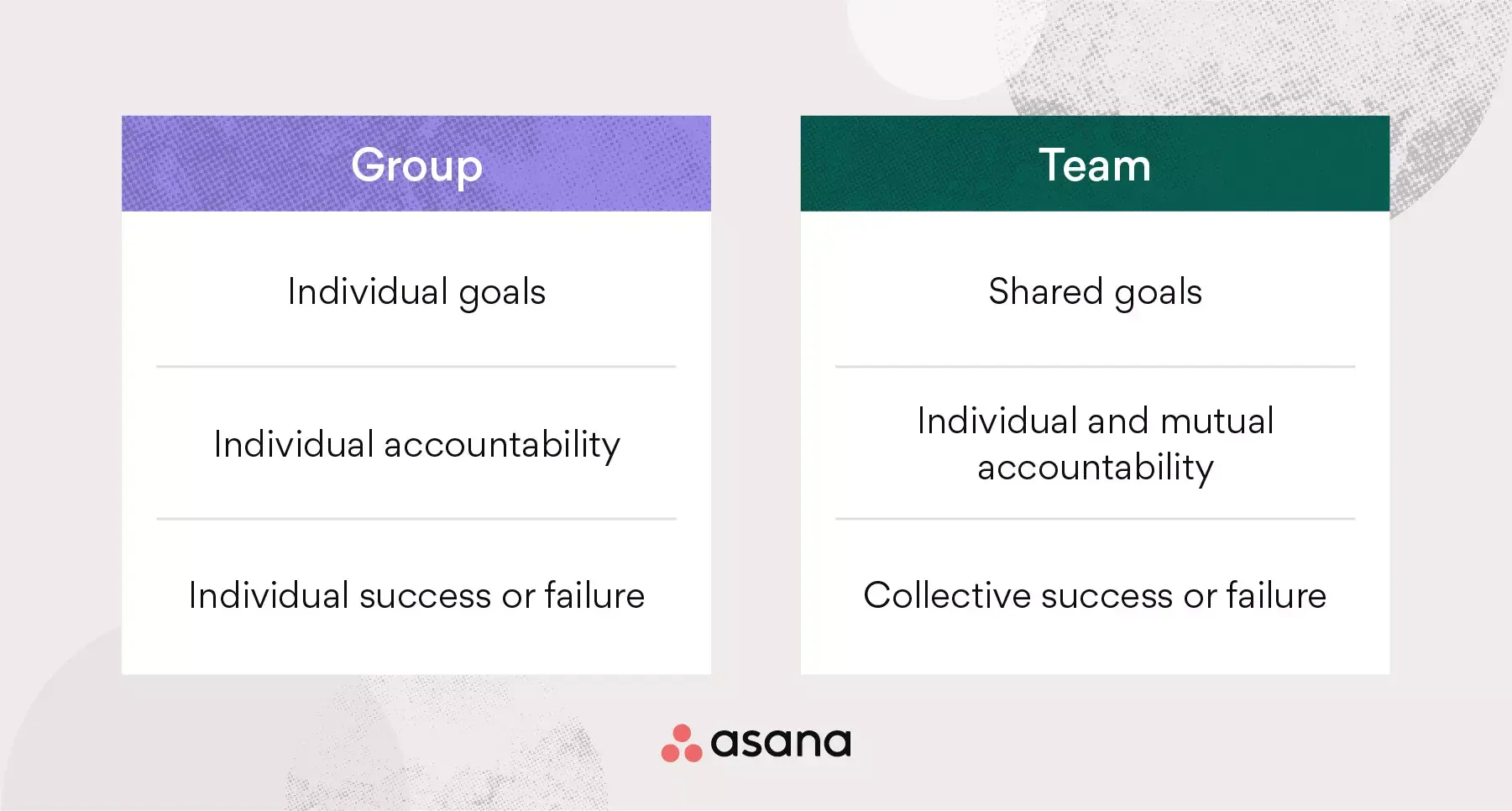
In a work group, group members are independent of one another and accountable individually. In a team, members share mutual accountability and work closely together to solve problems. These dynamics inform the way tasks are handled and overall collaboration.
Key differences between groups and teams
While groups and teams are both collections of people working together, their functions are quite different. The main distinctions come down to their goals, accountability, and how they collaborate. Here's a quick look at the key differences.
Group | Team | |
Goals | Members have individual goals, and their work is coordinated around a shared interest. | Members share a common purpose and work toward a collective goal. |
Accountability | Each person is accountable for their own tasks and outcomes. | Members share mutual accountability for the team's overall success. |
Collaboration | Members work independently. Their work is the sum of individual efforts. | Members work interdependently, relying on one another to complete tasks. |
Focus | Focused on individual efficiency and completing separate tasks. | Focused on creating synergy and achieving a collective outcome. |
Leadership e cambiamento: aumentare la chiarezza e creare un clima di fiducia
In questo webinar, gli esperti di Asana offrono suggerimenti concreti per guidare il tuo team attraverso l'incertezza. Scopri come aiutare i dipendenti a concentrarsi su ciò che conta davvero.


What is a group?
A group is a collection of people who work together toward individual goals. While members share a related interest or identity, they operate independently rather than interdependently.
Key characteristics of a group include:
Individual accountability: Each member is responsible for their own work
Parallel work: Members work alongside each other, not together
Shared interest: A common identity or interest brings them together
There are two types of groups: informal groups and formal groups. Informal groups are formed naturally around common interests, identities, or social goals. Formal groups are created by company leaders to perform specific tasks for the organization.
Group advantages
Both groups and teams have advantages and disadvantages. Here are the key benefits of working in a group:
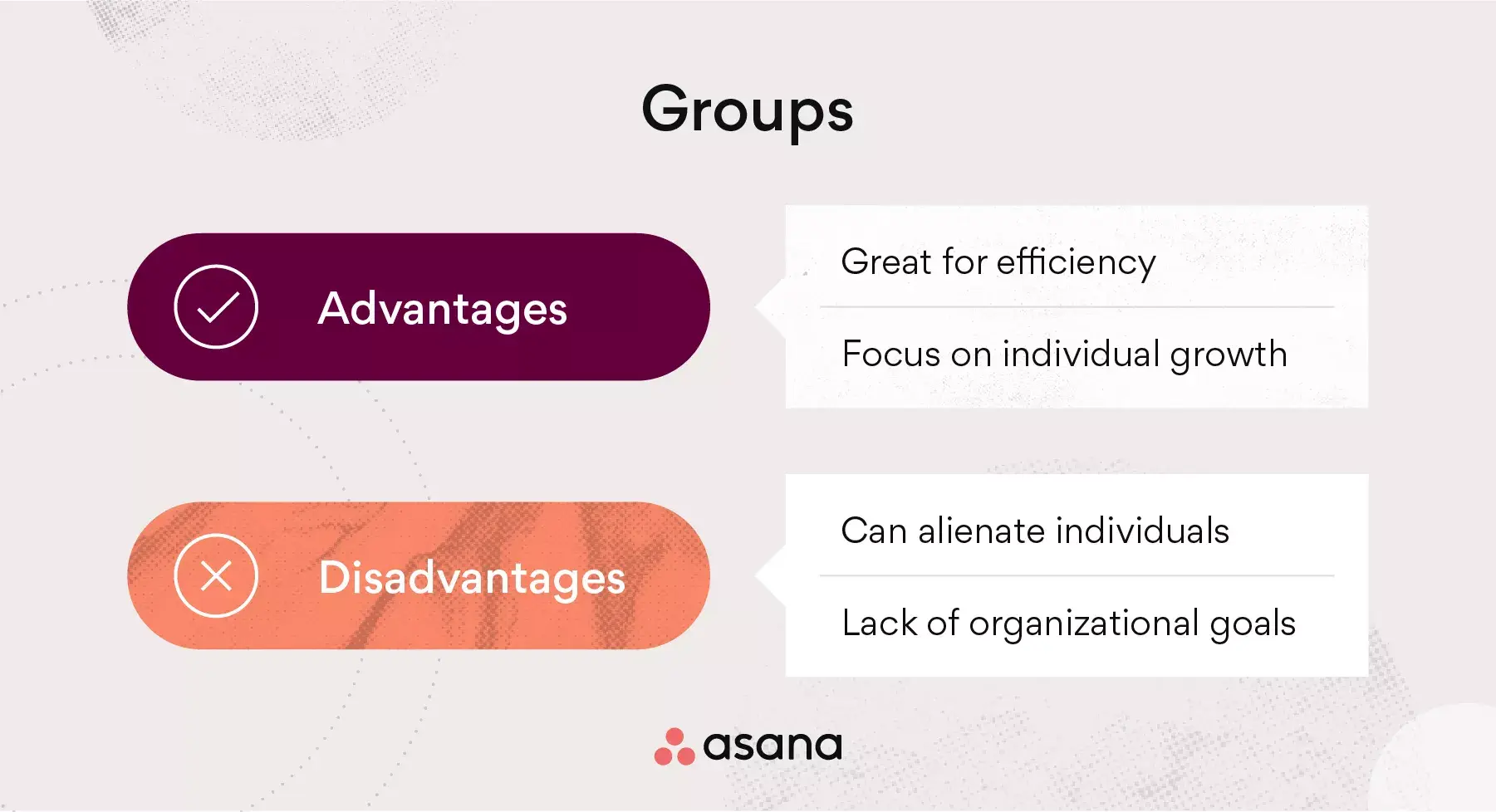
Groups build temporary relationships: Since groups focus on individual members working in parallel, they form temporary working relationships, such as short-term external projects or temporary internal consulting.
Groups are great for efficiency: While teams work to create efficiency for the greater good, groups focus on individual efficiency. This can improve effectiveness when looking at individual work and larger group objectives.
Groups focus on individual growth: Since groups support individual work, they also focus on individual growth. This can be seen as individual experts rather than a team of experts.
Group drawbacks
While groups support individual work and career growth, they don't share all of the advantages of working in a team setting. Here are the key disadvantages:
Groups can alienate individuals: Since groups work individually, there isn't as much time spent on team building. This lack of teamwork can alienate individuals and cause communication issues.
Groups don't support organizational goals: This lack of teamwork can cause a gap in organizational clarity. It makes it difficult to connect work to organizational goals and objectives.
These disadvantages are why some organizations prefer working in teams.
What is a team?
A team is a group of people who work together to accomplish a shared purpose or goal. Members rely on one another to achieve collective outcomes.
Key characteristics of a team include:
Shared accountability: Members are mutually responsible for outcomes
Interdependent work: Members rely on each other to complete tasks
Common purpose: Everyone works toward the same goal
Teams work together to solve problems, create new products, and align around shared purpose. Common types include cross-departmental teams, process teams, and self-managed teams.
Team advantages
Many organizations prefer teams over groups because of the collaborative advantages. Here are the key benefits of working in a team:
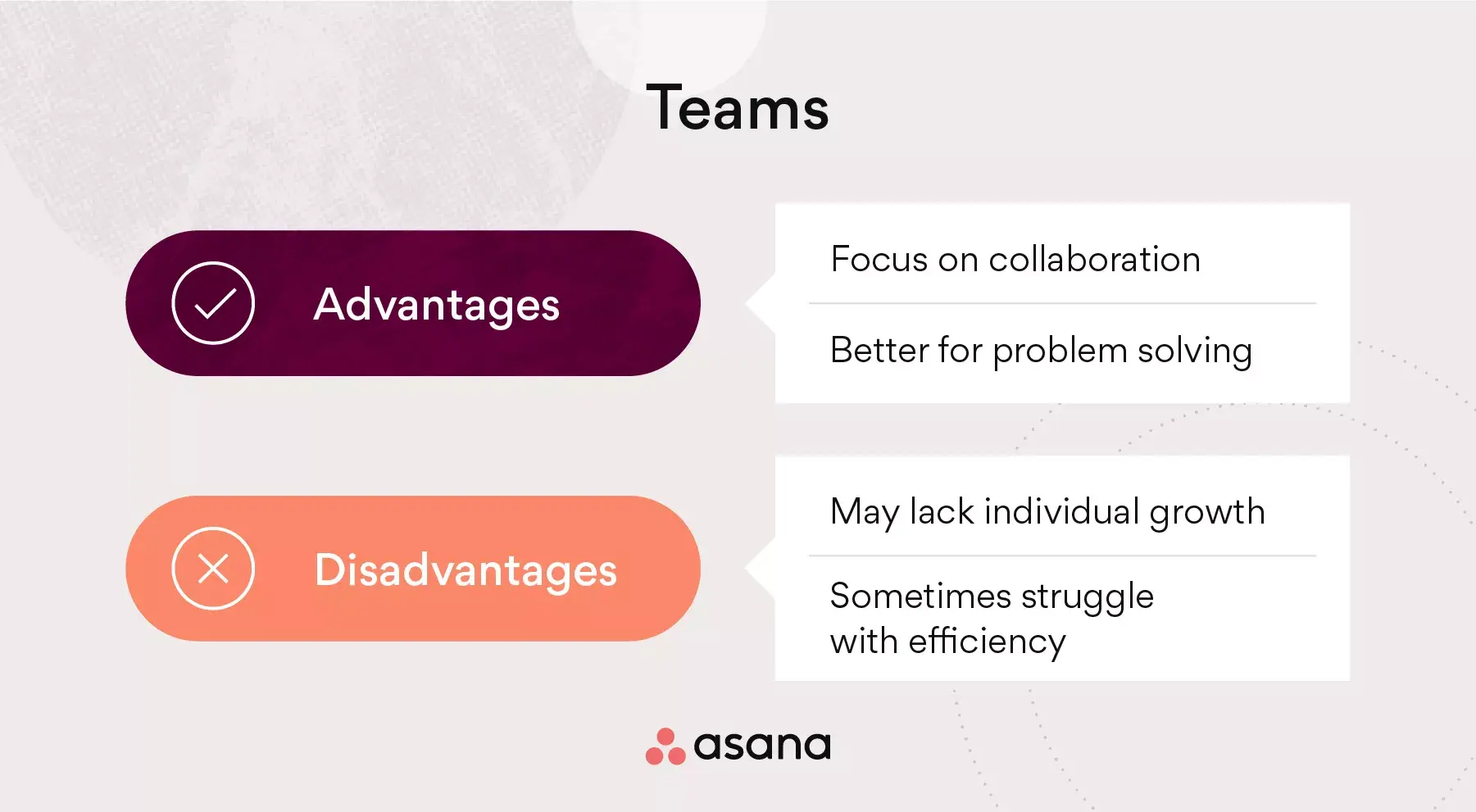
Teams build on collaboration and synergy: Teamwork can increase collaboration and synergy. These help support the overall goal and can aid in communication and organizational transparency.
Teams encourage group productivity: While groups improve efficiency, teams are more productive. Team members support each other's work, making the actual work more productive.
Teams are better for problem solving: The more people brainstorm together, the better. Teamwork helps solve problems more quickly and effectively the first time around.
Team drawbacks
While teams have many advantages, they also have some disadvantages. Here are the key drawbacks:
Teams don't always focus on individual growth: Some teams struggle with fostering individual growth. Outcomes are often focused on the greater good rather than what's best for each person.
Teams may struggle with efficiency: Teams can struggle with efficiency if the right organizational processes are not in place. This can cause work to take longer than expected and deadlines to be missed.
There are ways to minimize these effects with the right processes and leadership. The key is to facilitate organizational clarity that supports team effectiveness and individual growth.
How to lead groups vs. teams
Now that you understand the advantages and disadvantages of groups vs. teams, you may be wondering how to lead each effectively. Adapting your leadership style to the structure you're working with is key. Here's what to consider for each type of organization.
Group-focused organizations
Group dynamics describe the interactions, attitudes, and behaviors between members. These dynamics can positively or negatively affect collaboration.
Healthy group dynamics: Fluid collaboration, transparency, and open communication
Unhealthy group dynamics: Siloed work, individual isolation, and communication breakdowns
To prevent unhealthy dynamics, implement strategies that break down communication barriers.
Group leadership tip: Organize team-building games to encourage group collaboration and healthy dynamics.
Team-focused organizations
Team-focused organizations tend to have more transparency and fewer communication issues because members work interdependently toward shared goals. To strengthen team dynamics:
Keep collective goals visible: Ensure everyone understands the shared purpose
Empower interdependence: Encourage members to rely on one another
Communicate objectives: Align project goals with business goals
Spark collaboration by transitioning from group to team
The right dynamic for your organization depends on your goals and work style. Team dynamics typically empower stronger collaboration in the workplace and interdependent relationships, while groups support individual efficiency and growth.
Whether you lead a group or a team, prioritize clear communication and keep individual growth in sight. Asana helps you track tasks and keep everyone organized in a shared workspace. Get started today.
Leadership e cambiamento: aumentare la chiarezza e creare un clima di fiducia
In questo webinar, gli esperti di Asana offrono suggerimenti concreti per guidare il tuo team attraverso l'incertezza. Scopri come aiutare i dipendenti a concentrarsi su ciò che conta davvero.
Frequently asked questions about groups and teams
Yes, a group can become a team when members shift from individual to mutual accountability and start working interdependently. The transition typically takes a few weeks to several months, depending on leadership and clarity of shared purpose.
A group structure works best for tasks that can be completed efficiently by individuals working in parallel, such as customer support agents handling their own tickets. Choose a group when the work doesn't require deep collaboration and the focus is on individual productivity.
A group coordinates individual efforts toward separate goals, a team shares mutual accountability for a common goal, and a committee is a formal group appointed for a specific function like decision-making or oversight.